industrydif.com
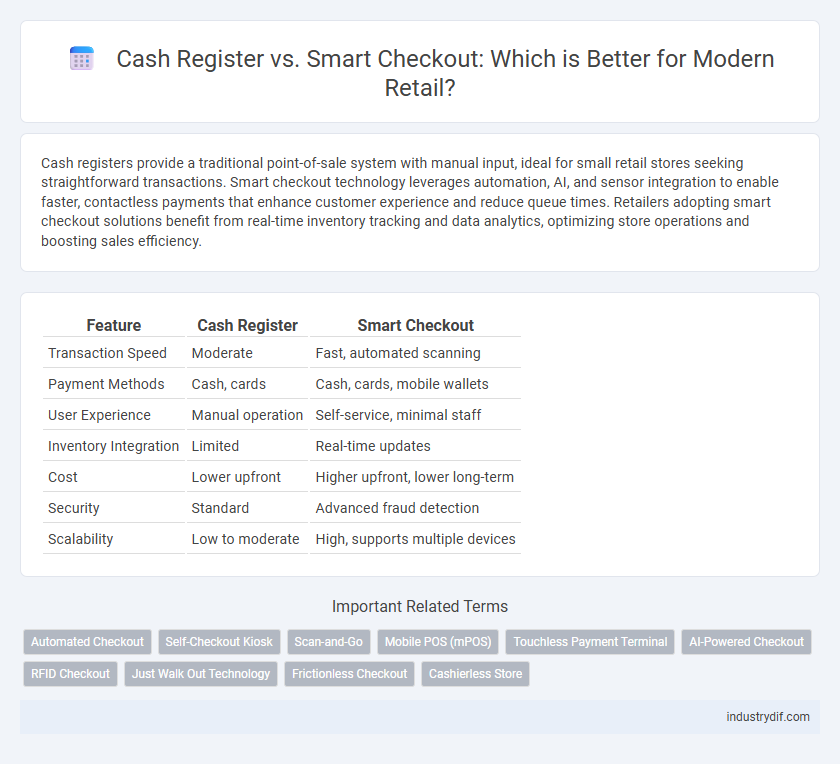
 Cash registers provide a traditional point-of-sale system with manual input, ideal for small retail stores seeking straightforward transactions. Smart checkout technology leverages automation, AI, and sensor integration to enable faster, contactless payments that enhance customer experience and reduce queue times. Retailers adopting smart checkout solutions benefit from real-time inventory tracking and data analytics, optimizing store operations and boosting sales efficiency.
Table of Comparison
| Feature | Cash Register | Smart Checkout |
|---|---|---|
| Transaction Speed | Moderate | Fast, automated scanning |
| Payment Methods | Cash, cards | Cash, cards, mobile wallets |
| User Experience | Manual operation | Self-service, minimal staff |
| Inventory Integration | Limited | Real-time updates |
| Cost | Lower upfront | Higher upfront, lower long-term |
| Security | Standard | Advanced fraud detection |
| Scalability | Low to moderate | High, supports multiple devices |
Introduction to Retail Checkout Systems
Retail checkout systems have evolved from traditional cash registers to advanced smart checkout solutions that integrate barcode scanning, digital payment processing, and inventory management. Cash registers primarily handle cash transactions and basic sales recording, while smart checkout systems leverage artificial intelligence and mobile technology to enhance speed, accuracy, and customer convenience. The transition to smart checkout improves operational efficiency and supports omnichannel retail strategies by streamlining checkout experiences and providing real-time sales analytics.
Defining Cash Registers and Smart Checkout
Cash registers are traditional point-of-sale systems that handle basic transaction processing, including scanning items, calculating totals, and managing cash payments. Smart checkout systems leverage advanced technologies like computer vision, AI, and IoT sensors to enable automated, cashier-less checkouts and seamless payment experiences. Retailers adopting smart checkout solutions benefit from reduced queue times, enhanced inventory tracking, and improved customer satisfaction.
Key Features of Traditional Cash Registers
Traditional cash registers feature manual keypads, receipt printers, and cash drawers designed for basic transaction processing. They typically lack integrated inventory management and rely on manual price entry, limiting efficiency and data tracking capabilities. These devices serve primarily as point-of-sale terminals, with minimal connectivity to broader retail systems compared to smart checkout solutions.
Advantages of Smart Checkout Solutions
Smart checkout solutions enhance retail efficiency by reducing wait times through automated scanning and payment processes, offering seamless customer experiences. These systems provide real-time inventory management and data analytics, empowering retailers to optimize stock levels and personalize marketing strategies effectively. Additionally, smart checkouts minimize human errors and lower labor costs, driving higher accuracy and operational savings compared to traditional cash registers.
Cost Comparison: Cash Register vs Smart Checkout
Cash registers typically involve lower upfront costs but incur higher long-term expenses due to maintenance, limited functionality, and slower transaction speeds. Smart checkout systems require a larger initial investment but reduce operational costs through automation, faster processing, and enhanced inventory management. Over time, smart checkout solutions offer improved ROI by minimizing labor expenses and increasing transaction efficiency in retail environments.
Impact on Customer Experience
Smart checkout systems enhance customer experience by significantly reducing wait times through automated scanning and payment processes, leading to faster and more efficient transactions compared to traditional cash registers. These advanced systems often integrate AI and IoT technologies, providing personalized promotions and seamless payment options that cater to individual customer preferences. In contrast, cash registers rely heavily on manual input, which can increase human error and delay service, ultimately affecting overall satisfaction and store throughput.
Integration with Inventory Management
Smart checkout systems seamlessly integrate with inventory management software, enabling real-time stock updates and reducing discrepancies. Traditional cash registers often lack this connectivity, causing manual entry errors and delays in inventory tracking. Enhanced integration in smart checkouts streamlines operations, improves accuracy, and supports automated reorder processes.
Security and Fraud Prevention
Smart checkout systems incorporate advanced security features such as biometric authentication, AI-driven fraud detection, and encrypted transactions, significantly reducing the risk of theft and fraudulent activities compared to traditional cash registers. Cash registers primarily rely on manual oversight, which increases vulnerability to cash skimming, employee theft, and counterfeit currency. Enhanced data analytics in smart checkouts enable real-time monitoring and anomaly detection, providing a proactive approach to fraud prevention in retail environments.
Scalability for Growing Retail Businesses
Smart checkout systems offer superior scalability for growing retail businesses by easily integrating with digital inventory management, customer data analytics, and mobile payment solutions. Traditional cash registers often face limitations in accommodating increased transaction volumes and expanding store operations without significant hardware upgrades. Implementing smart checkout technology enables retailers to streamline checkout processes, improve customer experience, and adapt quickly to changing market demands.
Future Trends in Retail Checkout Technology
Smart checkout technology is rapidly transforming retail by integrating AI, computer vision, and IoT to enable seamless, cashier-less transactions that reduce wait times and enhance customer experience. Future trends point toward widespread adoption of biometric authentication and real-time inventory syncing, allowing personalized, frictionless purchases both in-store and online. As retailers invest in these innovations, traditional cash registers are becoming obsolete, paving the way for more efficient, data-driven checkout ecosystems.
Related Important Terms
Automated Checkout
Automated checkout systems in retail, such as smart checkouts, utilize advanced technologies like RFID, computer vision, and AI to enable faster, contactless transactions compared to traditional cash registers. These systems reduce queue times, minimize human errors, and enhance customer experience by streamlining payment and inventory management processes.
Self-Checkout Kiosk
Self-checkout kiosks revolutionize retail by enabling customers to scan and pay for items independently, reducing wait times compared to traditional cash registers. These smart checkout systems integrate advanced technologies like barcode scanning, mobile payments, and AI-powered fraud detection, enhancing operational efficiency and customer convenience.
Scan-and-Go
Scan-and-Go technology in smart checkout systems significantly reduces transaction times by enabling customers to scan items using their smartphones before reaching the payment counter, enhancing convenience and minimizing queues. Traditional cash registers rely on manual scanning by cashiers, which often leads to longer wait times and decreased operational efficiency.
Mobile POS (mPOS)
Mobile POS (mPOS) systems empower retailers with portable, flexible checkout solutions that enhance customer experience through faster transactions and personalized service, contrasting with traditional cash registers that are stationary and limited in functionality. The integration of smart checkout technologies in mPOS enables seamless inventory management, real-time data analytics, and contactless payment options, driving operational efficiency and increased sales in retail environments.
Touchless Payment Terminal
Touchless payment terminals at smart checkouts enhance retail efficiency by reducing transaction times and minimizing physical contact, improving customer convenience and hygiene. Unlike traditional cash registers, these systems support NFC and mobile wallet integrations, enabling seamless, secure payment experiences that align with modern consumer preferences.
AI-Powered Checkout
AI-powered smart checkout systems revolutionize retail by reducing transaction times and enhancing customer experience through automated item recognition and seamless payment processing. Unlike traditional cash registers, these advanced systems leverage machine learning algorithms to minimize human error and optimize inventory management in real-time.
RFID Checkout
RFID checkout systems enhance retail efficiency by accelerating transaction speeds and reducing human error compared to traditional cash registers. Integrating RFID technology enables automatic item recognition, inventory tracking, and seamless payment processing, transforming the in-store shopping experience.
Just Walk Out Technology
Just Walk Out technology revolutionizes retail by eliminating traditional cash registers, allowing customers to shop and leave without stopping for payment. This seamless system uses a combination of sensors, cameras, and AI to automatically detect products taken and charge them to the customer's account, enhancing convenience and reducing checkout times.
Frictionless Checkout
Smart checkout systems leverage advanced technologies like AI, computer vision, and RFID to enable frictionless checkout experiences, significantly reducing customer wait times compared to traditional cash registers. These systems enhance retail efficiency by automating payment processes, minimizing human errors, and providing seamless transactions that improve overall customer satisfaction.
Cashierless Store
Cashierless stores utilize smart checkout technology to eliminate the need for traditional cash registers and human cashiers, enabling faster, frictionless transactions through sensors and AI-driven systems. These automated systems improve inventory accuracy and enhance customer experience by reducing wait times and enabling seamless payment options without manual barcode scanning.
Cash Register vs Smart Checkout Infographic