industrydif.com
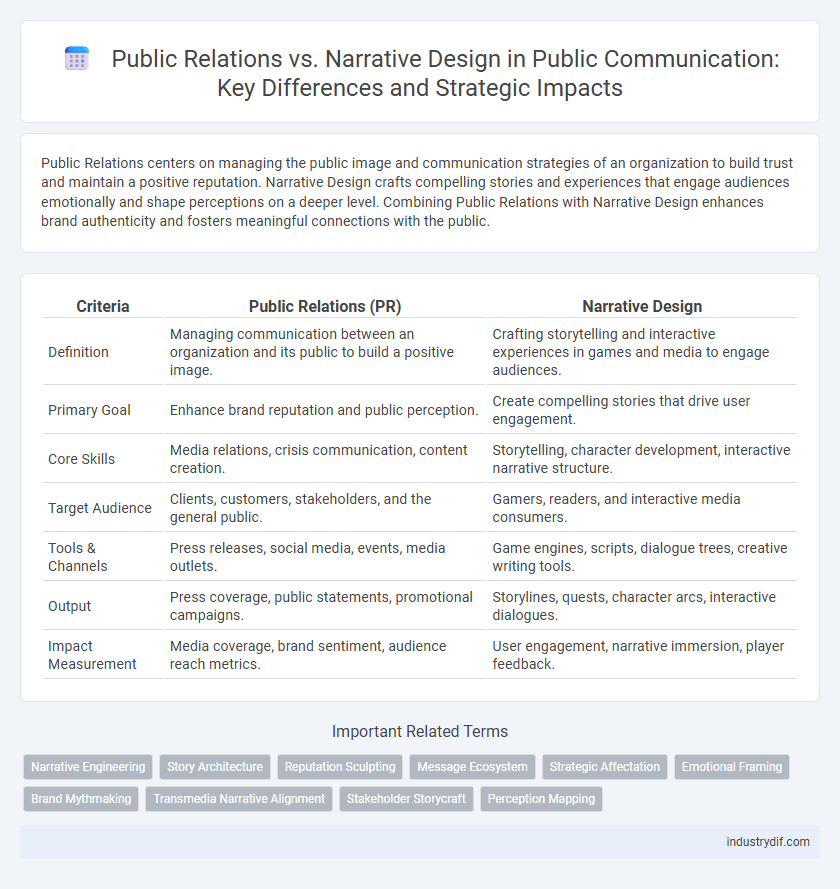
 Public Relations centers on managing the public image and communication strategies of an organization to build trust and maintain a positive reputation. Narrative Design crafts compelling stories and experiences that engage audiences emotionally and shape perceptions on a deeper level. Combining Public Relations with Narrative Design enhances brand authenticity and fosters meaningful connections with the public.
Table of Comparison
| Criteria | Public Relations (PR) | Narrative Design |
|---|---|---|
| Definition | Managing communication between an organization and its public to build a positive image. | Crafting storytelling and interactive experiences in games and media to engage audiences. |
| Primary Goal | Enhance brand reputation and public perception. | Create compelling stories that drive user engagement. |
| Core Skills | Media relations, crisis communication, content creation. | Storytelling, character development, interactive narrative structure. |
| Target Audience | Clients, customers, stakeholders, and the general public. | Gamers, readers, and interactive media consumers. |
| Tools & Channels | Press releases, social media, events, media outlets. | Game engines, scripts, dialogue trees, creative writing tools. |
| Output | Press coverage, public statements, promotional campaigns. | Storylines, quests, character arcs, interactive dialogues. |
| Impact Measurement | Media coverage, brand sentiment, audience reach metrics. | User engagement, narrative immersion, player feedback. |
Understanding Public Relations: Core Definitions
Public Relations involves managing communication between an organization and its audience to build a positive reputation and foster trust. Narrative Design focuses on crafting compelling stories that engage audiences emotionally and drive desired actions. Understanding Public Relations requires grasping key concepts such as strategic messaging, audience segmentation, and reputation management.
Narrative Design Explained: Shaping the Story
Narrative design focuses on crafting compelling and coherent stories that engage audiences emotionally and intellectually through carefully structured plot, character development, and thematic elements. Unlike public relations, which emphasizes managing brand reputation and communication strategies, narrative design prioritizes shaping the story experience across various media platforms to create immersive and meaningful connections. Effective narrative design incorporates user interaction and nonlinear storytelling techniques to enhance engagement and influence audience perception.
Key Differences Between Public Relations and Narrative Design
Public Relations focuses on managing an organization's image and communication with external audiences through strategic messaging, media relations, and crisis management. Narrative Design centers on creating cohesive and immersive stories, often used in games, media, and branding to engage audiences emotionally and contextually. While Public Relations aims at shaping public perception and maintaining reputation, Narrative Design crafts the underlying story framework to drive audience engagement and experience.
The Role of Messaging in Public Relations
Messaging in Public Relations shapes public perception by crafting clear, consistent communication aligned with organizational goals. Effective messaging leverages audience insights and media channels to build trust and manage reputation. Unlike Narrative Design, which focuses on storytelling frameworks, PR messaging prioritizes strategic adaptability to real-time events and stakeholder interests.
Narrative Structure and Its Impact on Audience Engagement
Narrative design structures storytelling by strategically connecting characters, events, and themes to evoke emotional responses and foster deeper audience engagement. Public relations leverages narrative structure to craft compelling brand stories that enhance reputation and build trust among target audiences. Effective narrative design increases message retention and drives audience actions by creating coherent, memorable experiences aligned with organizational goals.
Aligning Brand Voice: PR Strategies vs Narrative Frameworks
Aligning brand voice in public relations involves crafting consistent messaging that resonates across media channels, leveraging storytelling techniques to enhance audience engagement and credibility. Narrative design focuses on building immersive frameworks that shape the brand's identity through character development, plot structure, and thematic coherence, ensuring a deeper emotional connection with the target audience. Effective integration of PR strategies with narrative frameworks creates a unified brand voice that authentically reflects core values and adapts seamlessly to evolving market dynamics.
Crisis Management: PR Tactics vs Narrative Responses
Public Relations crisis management employs strategic communication to control information flow, mitigate reputational damage, and restore public trust through timely press releases, media briefings, and stakeholder engagement. Narrative Design in crisis response crafts a coherent story that shapes audience perception by addressing underlying values, emotions, and motivations, facilitating long-term relationship rebuilding. Integrating PR tactics with narrative responses enhances crisis resolution effectiveness by combining factual clarity with emotional resonance.
Measuring Success: Public Perception vs Story Resonance
Measuring success in Public Relations centers on shifts in public perception, using metrics like media coverage, sentiment analysis, and brand awareness surveys to gauge impact. In contrast, Narrative Design evaluates story resonance through audience engagement, emotional connection, and narrative recall, often tracked via qualitative feedback and interaction analytics. Both rely on data-driven insights, yet Public Relations emphasizes external reputation metrics while Narrative Design prioritizes internal audience experience.
Integrating PR and Narrative Design for Maximum Impact
Integrating Public Relations and Narrative Design amplifies brand storytelling by aligning strategic communication with compelling narratives that resonate with target audiences. Effective collaboration between PR professionals and narrative designers ensures message consistency, emotional engagement, and greater media traction across platforms. This synergy drives stronger brand loyalty, enhances reputation management, and maximizes overall communication impact.
Future Trends: Evolving Roles in Public Communication
Public Relations is increasingly integrating narrative design techniques to craft immersive brand stories that resonate emotionally with diverse audiences. Future trends highlight the shift from traditional press releases to dynamic storytelling platforms powered by AI and interactive media, enhancing engagement and authenticity. This evolution redefines public communication roles, blending strategic messaging with creative narrative construction to drive deeper stakeholder connections.
Related Important Terms
Narrative Engineering
Narrative engineering in Public Relations involves strategically crafting and controlling stories to shape public perception and influence audience behavior. Unlike traditional PR that focuses on message dissemination, narrative design emphasizes the construction of cohesive, emotionally resonant narratives that drive engagement and brand loyalty.
Story Architecture
Public Relations crafts strategic messaging to shape brand perception, while Narrative Design focuses on story architecture to build immersive, cohesive experiences. Story architecture integrates character development, plot progression, and thematic elements to engage audiences emotionally and intellectually.
Reputation Sculpting
Public Relations strategically manages media communication and stakeholder perceptions to maintain a positive corporate image, while Narrative Design crafts compelling, consistent storytelling that shapes the emotional and ethical dimensions of a brand's reputation. Reputation sculpting integrates PR's external message control with narrative design's immersive story arcs, ensuring a coherent identity that resonates authentically with target audiences.
Message Ecosystem
Public Relations centers on managing a message ecosystem to shape public perception through strategic communication channels and media engagement, while Narrative Design crafts immersive story worlds that engage audiences by structuring interconnected narrative elements. The message ecosystem in Public Relations integrates brand messaging, stakeholder narratives, and media touchpoints to maintain consistency and amplify influence across diverse platforms.
Strategic Affectation
Public Relations strategically shapes audience perception by managing communications and media relations to build brand reputation, while Narrative Design strategically crafts immersive stories and emotional experiences to influence engagement and behavior. Both disciplines employ targeted messaging techniques, but Public Relations emphasizes external stakeholder trust, whereas Narrative Design prioritizes emotional resonance and interactive immersion.
Emotional Framing
Emotional framing in public relations leverages storytelling techniques to shape audience perceptions and elicit targeted emotional responses, thereby enhancing brand loyalty and trust. Narrative design strategically structures these emotional cues within a cohesive storyline, ensuring consistent messaging that resonates deeply with the audience's values and experiences.
Brand Mythmaking
Public Relations strategically shapes brand image through targeted communication and reputation management, while Narrative Design crafts immersive stories that embed brand mythmaking into consumer experiences. Brand mythmaking leverages Archetypes and symbolic narratives to create emotional connections, reinforcing identity and loyalty beyond traditional PR tactics.
Transmedia Narrative Alignment
Public Relations strategically manages brand perception through coordinated messaging across multiple media channels, ensuring consistent audience engagement. Narrative Design in transmedia focuses on crafting interconnected story elements that align seamlessly across platforms, enhancing immersive brand storytelling and reinforcing PR efforts.
Stakeholder Storycraft
Public Relations strategically manages stakeholder storycraft by shaping and disseminating narratives that build trust, enhance reputation, and align with organizational goals. Narrative Design focuses on crafting immersive, cohesive stories that engage stakeholders emotionally and intellectually, driving deeper connection and long-term loyalty.
Perception Mapping
Public Relations leverages perception mapping to analyze and shape audience attitudes by tracking sentiment, media coverage, and stakeholder feedback, enabling targeted communication strategies. Narrative design uses perception mapping to construct cohesive stories that align brand identity with audience values, enhancing emotional engagement and reinforcing desired perceptions.
Public Relations vs Narrative Design Infographic