industrydif.com
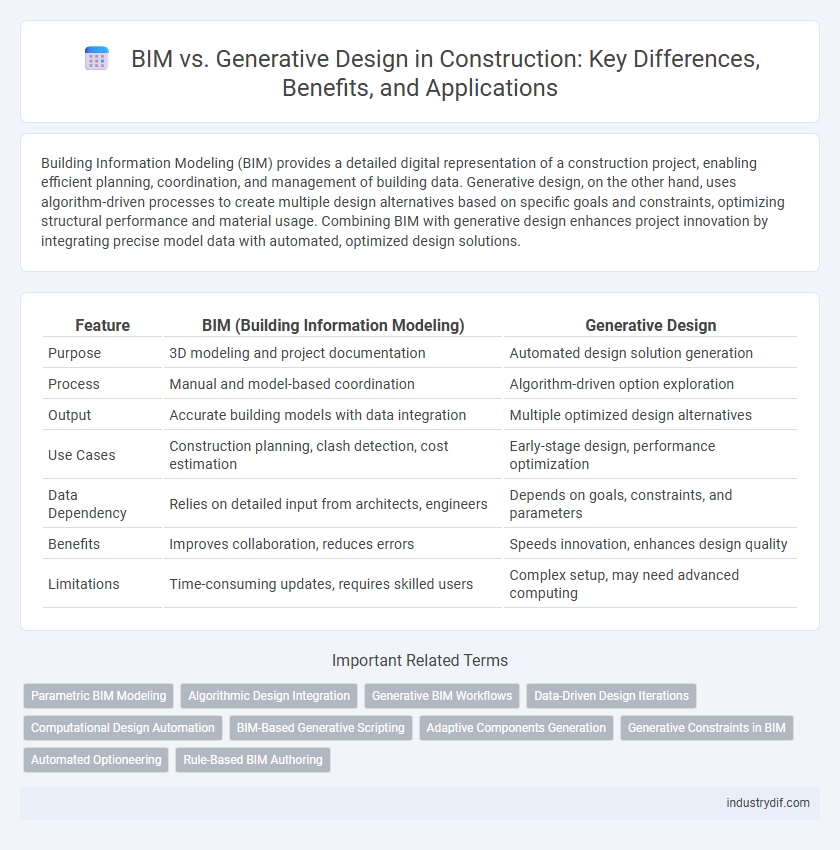
 Building Information Modeling (BIM) provides a detailed digital representation of a construction project, enabling efficient planning, coordination, and management of building data. Generative design, on the other hand, uses algorithm-driven processes to create multiple design alternatives based on specific goals and constraints, optimizing structural performance and material usage. Combining BIM with generative design enhances project innovation by integrating precise model data with automated, optimized design solutions.
Table of Comparison
| Feature | BIM (Building Information Modeling) | Generative Design |
|---|---|---|
| Purpose | 3D modeling and project documentation | Automated design solution generation |
| Process | Manual and model-based coordination | Algorithm-driven option exploration |
| Output | Accurate building models with data integration | Multiple optimized design alternatives |
| Use Cases | Construction planning, clash detection, cost estimation | Early-stage design, performance optimization |
| Data Dependency | Relies on detailed input from architects, engineers | Depends on goals, constraints, and parameters |
| Benefits | Improves collaboration, reduces errors | Speeds innovation, enhances design quality |
| Limitations | Time-consuming updates, requires skilled users | Complex setup, may need advanced computing |
Understanding BIM and Generative Design
Building Information Modeling (BIM) is a digital representation of a construction project's physical and functional characteristics, enabling enhanced collaboration and data management throughout the project lifecycle. Generative Design uses algorithms and computational processes to automatically generate multiple design alternatives based on specified constraints and goals, optimizing architectural and structural solutions. Understanding BIM's role in data integration and Generative Design's capacity for innovative problem-solving is essential for leveraging these technologies to improve construction efficiency and project outcomes.
Core Principles of BIM in Construction
Building Information Modeling (BIM) is centered on creating a digital representation of the physical and functional characteristics of a construction project, enabling enhanced collaboration and data sharing among architects, engineers, and contractors. Core principles include 3D modeling, real-time data management, and lifecycle project visualization to improve accuracy and reduce errors during construction. Unlike Generative Design, BIM emphasizes structured information management and decision-making support throughout the entire project delivery process.
Key Features of Generative Design
Generative Design in construction utilizes algorithm-driven processes to create multiple design alternatives rapidly, optimizing for constraints such as material usage, structural performance, and cost efficiency. Unlike BIM, which focuses on detailed modeling and documentation, Generative Design emphasizes innovation by exploring complex design possibilities through artificial intelligence and machine learning. This approach enables architects and engineers to uncover optimal solutions that enhance sustainability and streamline project delivery timelines.
Workflow Comparison: BIM vs Generative Design
Building Information Modeling (BIM) streamlines construction workflows by creating detailed 3D models that integrate architectural, structural, and MEP systems for coordinated planning and clash detection. Generative Design enhances workflows through algorithm-driven exploration of design options, rapidly producing multiple iterations based on performance criteria and constraints, accelerating decision-making in early design stages. While BIM focuses on model accuracy and collaboration across disciplines, Generative Design prioritizes design optimization and innovation, complementing traditional BIM processes within an integrated construction workflow.
Benefits of BIM for Construction Projects
BIM enhances construction projects by enabling precise 3D visualization, which improves coordination among stakeholders and reduces costly errors. It facilitates detailed clash detection, streamlining the construction process and minimizing delays. By providing a comprehensive digital twin, BIM supports better project management, cost estimation, and lifecycle maintenance.
Advantages of Generative Design in Construction
Generative design in construction accelerates the creation of optimized building structures by utilizing algorithms to explore numerous design permutations, enhancing efficiency and material usage. It enables precise simulations of structural performance, reducing errors and minimizing costly rework compared to traditional BIM processes. This approach fosters innovation by integrating sustainability metrics and real-time data, ultimately driving smarter, more resilient construction projects.
Integration of BIM and Generative Design Technologies
The integration of Building Information Modeling (BIM) and generative design technologies revolutionizes construction workflows by enabling data-driven, optimized project outcomes. BIM provides comprehensive digital representations of physical and functional characteristics, while generative design uses algorithms to automatically produce design alternatives based on specified constraints and goals. Combining these technologies enhances collaboration, reduces errors, accelerates decision-making, and improves efficiency by creating more sustainable, cost-effective, and innovative building solutions.
Use Cases: Real-World Applications
Building Information Modeling (BIM) excels in project visualization, clash detection, and facility management, streamlining collaboration among architects, engineers, and contractors during construction and operation phases. Generative Design leverages algorithm-driven processes to optimize structural layouts, material usage, and energy efficiency, enabling innovative solutions in complex architectural forms and sustainable building designs. Real-world applications showcase BIM's effectiveness in coordinating large-scale infrastructure projects, while Generative Design drives customization and performance enhancements in residential and commercial developments.
Challenges and Limitations of Each Approach
Building Information Modeling (BIM) faces challenges such as high initial setup costs, complexity in managing large datasets, and limited flexibility in accommodating spontaneous design changes. Generative Design struggles with computational intensity, difficulty integrating real-world constraints, and requires specialized expertise to interpret complex algorithm-driven results. Both approaches encounter limitations in interoperability and user adaptation, hindering seamless integration within existing construction workflows.
Future Trends in Construction Technology
Building Information Modeling (BIM) integrates detailed digital representations of physical and functional characteristics, facilitating collaborative project management and accurate construction planning. Generative Design leverages AI algorithms to explore numerous design alternatives rapidly, optimizing for criteria like material efficiency, cost, and sustainability. The future of construction technology emphasizes combining BIM's precise data management with generative design's innovative capabilities, driving smarter, faster, and more sustainable building processes.
Related Important Terms
Parametric BIM Modeling
Parametric BIM modeling streamlines construction workflows by enabling dynamic adjustments to building components through linked parameters, enhancing precision and collaboration. Generative design complements this by automatically generating optimized design alternatives, but parametric BIM remains essential for detailed modeling and real-time changes in complex structures.
Algorithmic Design Integration
BIM (Building Information Modeling) centralizes project data management, enabling precise modeling and collaboration across construction teams, while Generative Design uses algorithmic processes to explore multiple design alternatives rapidly. Integrating algorithmic design within BIM enhances optimization by automating complex iterations and improving decision-making based on data-driven insights throughout the construction lifecycle.
Generative BIM Workflows
Generative BIM workflows integrate algorithm-driven design processes within Building Information Modeling, enabling automated optimization of architectural elements based on performance criteria such as energy efficiency, cost, and structural integrity. This synergy accelerates decision-making, reduces design iterations, and enhances collaboration by dynamically updating BIM models with generation-based design alternatives.
Data-Driven Design Iterations
BIM centralizes project data in a collaborative model, enabling precise coordination and visualization throughout the construction process, while Generative Design rapidly produces multiple design alternatives by leveraging algorithms and real-time data inputs for optimized outcomes. Data-driven design iterations in BIM enhance accuracy and compliance, whereas Generative Design accelerates innovation by continuously refining solutions based on performance metrics and constraints.
Computational Design Automation
Building Information Modeling (BIM) enables detailed digital representation of physical and functional characteristics in construction, while Generative Design leverages computational algorithms to automatically generate optimal design alternatives based on predefined constraints. Computational Design Automation integrates BIM data with generative algorithms to streamline project workflows, reduce errors, and accelerate decision-making in construction planning and execution.
BIM-Based Generative Scripting
BIM-Based Generative Scripting integrates Building Information Modeling with algorithm-driven design processes, enabling automated generation of complex architectural geometries and optimized construction workflows. This approach enhances project accuracy and efficiency by leveraging parametric data to iteratively test design variations within the BIM environment.
Adaptive Components Generation
BIM enables precise modeling of standard and custom building elements, while generative design leverages algorithms to create adaptive components that respond dynamically to project constraints and performance criteria. Integrating generative design within BIM workflows enhances adaptive components generation by optimizing form, material use, and structural efficiency in construction projects.
Generative Constraints in BIM
Generative design within BIM leverages predefined constraints such as structural integrity, material properties, and zoning regulations to automatically produce optimized building models that meet project requirements. Integrating generative constraints enhances BIM workflows by enabling rapid exploration of design alternatives while ensuring compliance with engineering and environmental standards.
Automated Optioneering
Automated optioneering in construction leverages Building Information Modeling (BIM) for detailed project visualization, while generative design enhances this process by rapidly generating and evaluating multiple design alternatives based on performance criteria. Integrating BIM data with generative design algorithms accelerates decision-making, optimizing cost, sustainability, and structural efficiency throughout the project lifecycle.
Rule-Based BIM Authoring
Rule-Based BIM Authoring utilizes predefined protocols and standards to automate the creation of building information models, ensuring consistency and compliance with project requirements. Unlike Generative Design, which explores multiple design alternatives through algorithmic processes, Rule-Based BIM focuses on applying deterministic rules to streamline model accuracy and coordination in construction workflows.
BIM vs Generative Design Infographic