industrydif.com
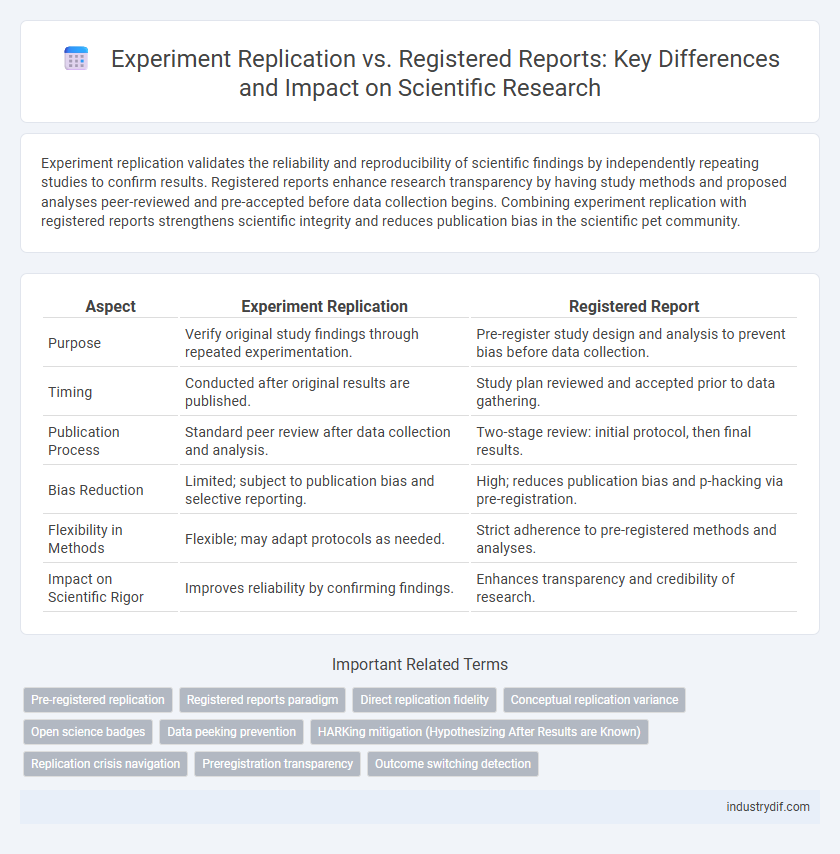
 Experiment replication validates the reliability and reproducibility of scientific findings by independently repeating studies to confirm results. Registered reports enhance research transparency by having study methods and proposed analyses peer-reviewed and pre-accepted before data collection begins. Combining experiment replication with registered reports strengthens scientific integrity and reduces publication bias in the scientific pet community.
Table of Comparison
| Aspect | Experiment Replication | Registered Report |
|---|---|---|
| Purpose | Verify original study findings through repeated experimentation. | Pre-register study design and analysis to prevent bias before data collection. |
| Timing | Conducted after original results are published. | Study plan reviewed and accepted prior to data gathering. |
| Publication Process | Standard peer review after data collection and analysis. | Two-stage review: initial protocol, then final results. |
| Bias Reduction | Limited; subject to publication bias and selective reporting. | High; reduces publication bias and p-hacking via pre-registration. |
| Flexibility in Methods | Flexible; may adapt protocols as needed. | Strict adherence to pre-registered methods and analyses. |
| Impact on Scientific Rigor | Improves reliability by confirming findings. | Enhances transparency and credibility of research. |
Defining Experiment Replication
Experiment replication refers to the process of conducting a study again to verify the reliability and validity of its original findings by using the same methods and materials. It allows researchers to confirm results, identify errors, and assess the robustness of scientific claims across different settings or populations. This practice is fundamental in maintaining the credibility of empirical research through reproducibility and transparency.
What Is a Registered Report?
A Registered Report is a publishing format in scientific research where the study's methods and proposed analyses are peer-reviewed and accepted before data collection begins, ensuring transparency and reducing publication bias. This approach contrasts with traditional Experiment Replication by emphasizing pre-registered protocols to enhance research validity and reproducibility. Registered Reports promote scientific rigor by committing journals to publish results regardless of outcome, supporting open and reliable science.
Historical Context in Scientific Methodology
Experiment replication, a cornerstone of the scientific method since the 17th century, ensures the reliability and validity of research findings by independently reproducing study outcomes. The registered report format, introduced in the early 2010s, addresses publication bias by requiring peer review of hypotheses and methods before data collection, thus enhancing transparency and reducing selective reporting. This evolution reflects a shift from post-hoc confirmation towards pre-registered, hypothesis-driven research to improve reproducibility in scientific practice.
Key Differences: Replication vs Registered Report
Experiment replication tests the reliability of previous findings by independently repeating the study using the same methods and conditions. Registered reports involve peer review and in-principle acceptance of research protocols before data collection, promoting transparency and reducing publication bias. Key differences lie in replication's emphasis on confirming results versus registered reports' focus on methodological rigor and pre-commitment to study designs.
Importance for Scientific Validity
Experiment replication enhances scientific validity by verifying original findings through independent repetition, reducing false positives and increasing result reliability. Registered reports improve validity by pre-registering hypotheses and methods prior to data collection, minimizing publication bias and selective reporting. Together, these approaches strengthen transparency, reproducibility, and trustworthiness in scientific research.
Challenges in Replication Studies
Experiment replication faces challenges such as variability in experimental conditions, incomplete reporting of original methodologies, and difficulties in accessing original data sets. Registered reports mitigate some replication issues by pre-registering hypotheses and protocols, promoting transparency and reducing publication bias. However, replicating studies still struggles with standardizing procedures and accounting for contextual differences that impact reproducibility.
Registered Reports and Publication Bias
Registered Reports serve as an innovative publication format designed to combat publication bias by conducting peer review before data collection, ensuring that studies with null or negative results are published regardless of outcomes. This approach increases scientific transparency and reproducibility by prioritizing the research question and methodology over the results. Unlike traditional Experiment Replication, which attempts to reproduce results after initial publication, Registered Reports preemptively address selective reporting, reducing the likelihood of bias in scientific literature.
Impact on Research Transparency
Experiment replication enhances research transparency by verifying original findings through repeated studies, reducing publication bias and increasing reproducibility. Registered reports improve transparency by pre-registering study protocols and analysis plans, preventing selective reporting and enhancing methodological rigor. Combining replication efforts with registered reports creates a robust framework for transparent, credible scientific research.
Case Studies: Successes and Setbacks
Case studies in scientific research highlight the differing outcomes between experiment replication and registered reports, with replication efforts often revealing inconsistencies that challenge original findings. Registered reports enhance research transparency by peer-reviewing methods before data collection, leading to increased publication of null or negative results. Successes include improved reproducibility in psychology and cancer biology, while setbacks involve resource intensiveness and occasional resistance from the scientific community.
Future Trends in Research Integrity
Experiment replication enhances research integrity by verifying results and reducing false positives, while registered reports promote transparency through pre-registered methodologies and hypotheses. Future trends emphasize integrating these approaches with open science practices and machine learning tools to detect anomalies and ensure reproducibility. Embracing collaborative platforms and standardized protocols will further strengthen research reliability and accountability.
Related Important Terms
Pre-registered replication
Pre-registered replication involves documenting hypotheses, methods, and analysis plans prior to data collection, enhancing transparency and reducing bias in experiment replication. Registered reports further strengthen this approach by undergoing peer review before execution, ensuring methodological rigor and improved reproducibility in scientific research.
Registered reports paradigm
Registered reports enhance scientific rigor by requiring peer review of hypotheses and methodology before data collection, minimizing publication bias and p-hacking. This paradigm fosters transparency and reproducibility, contrasting with traditional experiment replication that occurs only post-publication.
Direct replication fidelity
Direct replication fidelity in experiments significantly enhances reliability by reproducing original conditions and methodologies with precision, minimizing deviations that could impact outcomes. Registered reports promote this fidelity by pre-registering study protocols, reducing bias and increasing transparency in replication efforts.
Conceptual replication variance
Conceptual replication variance arises when experiments test the same hypothesis using different methodologies, often leading to inconsistent results that challenge the reliability of scientific findings. Registered reports mitigate this issue by preregistering study designs and hypotheses, enhancing transparency and reducing selective reporting bias in replication studies.
Open science badges
Open science badges promote transparency and reproducibility by incentivizing practices such as data sharing and preregistration, which are critical in both experiment replication and registered reports. The presence of badges in published research enhances trust and facilitates verification, making them key tools in advancing rigorous scientific standards.
Data peeking prevention
Experiment replication relies on independent repetition of studies to verify results, while registered reports mitigate data peeking by requiring pre-registration of hypotheses and analysis plans, ensuring transparency and reducing publication bias. Pre-registration enforces adherence to predefined methods, effectively preventing selective reporting and p-hacking during data analysis.
HARKing mitigation (Hypothesizing After Results are Known)
Registered reports significantly reduce HARKing by requiring hypotheses and analysis plans to be pre-registered and peer-reviewed before data collection begins, ensuring transparency and preventing post hoc hypothesis formulation. Experiment replication promotes result verification but lacks preemptive measures against HARKing, making registered reports a more effective strategy for mitigating biased hypothesis testing in scientific research.
Replication crisis navigation
Experiment replication addresses the reproducibility challenges in scientific research by independently repeating studies to verify results, serving as a key method to mitigate the replication crisis. Registered Reports enhance transparency and reduce publication bias by peer-reviewing hypotheses and methods before data collection, creating complementary safeguards alongside replication efforts to improve research reliability.
Preregistration transparency
Experiment replication enhances scientific reliability by independently verifying results, while registered reports prioritize preregistration transparency by documenting hypotheses and methods prior to data collection, reducing selective reporting bias. Preregistration in registered reports ensures methodological rigor and accountability, fostering open science through public disclosure of research plans before experimentation begins.
Outcome switching detection
Experiment replication assesses the reproducibility of scientific findings by independently repeating studies, while registered reports involve pre-registering study protocols to prevent outcome switching and increase transparency; pre-registration serves as a crucial mechanism for detecting and mitigating selective outcome reporting, thereby enhancing the credibility of published results.
Experiment Replication vs Registered Report Infographic