industrydif.com
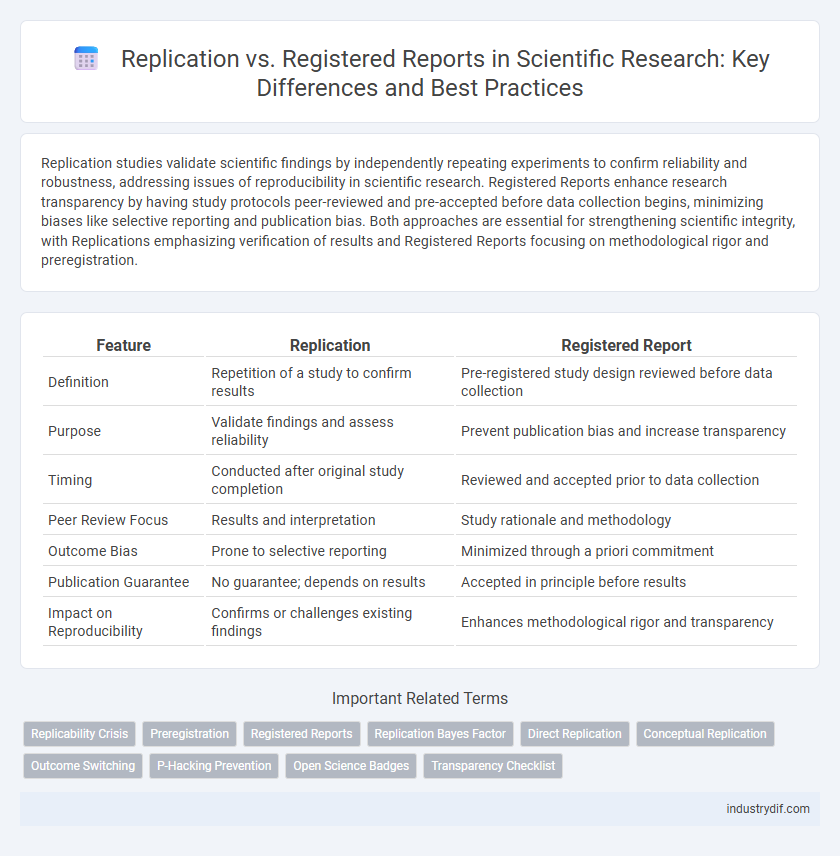
 Replication studies validate scientific findings by independently repeating experiments to confirm reliability and robustness, addressing issues of reproducibility in scientific research. Registered Reports enhance research transparency by having study protocols peer-reviewed and pre-accepted before data collection begins, minimizing biases like selective reporting and publication bias. Both approaches are essential for strengthening scientific integrity, with Replications emphasizing verification of results and Registered Reports focusing on methodological rigor and preregistration.
Table of Comparison
| Feature | Replication | Registered Report |
|---|---|---|
| Definition | Repetition of a study to confirm results | Pre-registered study design reviewed before data collection |
| Purpose | Validate findings and assess reliability | Prevent publication bias and increase transparency |
| Timing | Conducted after original study completion | Reviewed and accepted prior to data collection |
| Peer Review Focus | Results and interpretation | Study rationale and methodology |
| Outcome Bias | Prone to selective reporting | Minimized through a priori commitment |
| Publication Guarantee | No guarantee; depends on results | Accepted in principle before results |
| Impact on Reproducibility | Confirms or challenges existing findings | Enhances methodological rigor and transparency |
Defining Replication in Scientific Research
Replication in scientific research involves conducting a study again using the same methods and procedures to verify the original findings and ensure reliability. This process helps confirm the validity of experimental results and addresses issues related to reproducibility and scientific integrity. Registered reports differ by preregistering study protocols before data collection, whereas replication focuses on repeating experiments to strengthen evidence.
What is a Registered Report?
A Registered Report is a publishing format in scientific research where study methods and proposed analyses undergo peer review before data collection begins, enhancing transparency and reducing publication bias. This approach contrasts with traditional replication studies by prioritizing methodological rigor and pre-registered hypotheses over merely repeating experiments. Registered Reports improve reproducibility by committing journals to publish results regardless of outcome, emphasizing the scientific process rather than positive findings.
Key Differences: Replication vs Registered Report
Replication involves conducting a study again to verify original findings by reproducing the same methods and analyses, emphasizing empirical validation. Registered Reports require pre-registration of hypotheses and methodology before data collection, ensuring transparency and reducing publication bias. Key differences lie in Replication prioritizing verification of results, while Registered Reports focus on pre-commitment to study design to prevent selective reporting.
Importance of Transparency in Scientific Studies
Transparency in scientific studies enhances reproducibility by providing detailed methodologies, raw data, and analysis protocols, which is essential for both replication and registered reports. Replication studies validate original findings by independently confirming results, while registered reports pre-commit to hypotheses and methods, reducing publication bias and enhancing methodological transparency. Emphasizing transparency fosters trust, mitigates selective reporting, and strengthens the overall credibility of scientific research outcomes.
Addressing Publication Bias
Replication studies play a crucial role in verifying the reliability of scientific findings but often face challenges in publication due to negative or null results. Registered Reports mitigate publication bias by committing to peer review and publication based on research questions and methodology before results are known. This approach ensures that studies are judged by scientific rigor rather than outcome, promoting transparency and enhancing reproducibility in research.
Enhancing Reproducibility in Science
Replication studies systematically verify original research findings by independently repeating experiments, thereby directly assessing the reliability of scientific results. Registered Reports improve reproducibility by pre-registering study methods and analysis plans before data collection, minimizing bias and selective reporting. Combining replication efforts with Registered Reports creates a robust framework that strengthens scientific integrity and transparency.
Challenges with Replication Efforts
Replication efforts in scientific research face significant challenges including lack of standardized protocols, insufficient funding, and publication bias favoring novel findings over confirmatory studies. Variability in experimental conditions and incomplete reporting of original methods often lead to inconsistencies in replication results. Registered Reports address some of these issues by pre-registering hypotheses and methodologies, promoting transparency and reducing selective reporting.
Advantages of Registered Reports
Registered Reports enhance scientific transparency and reduce publication bias by committing to peer review before data collection, ensuring hypotheses and methods are scrutinized in advance. This pre-registration model promotes reproducibility by preventing selective reporting and p-hacking, leading to more robust and credible research outcomes. Researchers benefit from increased methodological rigor and publication guarantees, fostering trust in scientific findings.
Case Studies: Replication and Registered Report Outcomes
Case studies reveal that replication efforts frequently encounter challenges such as publication bias and varying effect sizes, emphasizing the need for stringent methodological standards. Registered reports systematically reduce these biases by pre-registering hypotheses and analysis plans, resulting in higher transparency and reproducibility of scientific outcomes. Comparative analyses demonstrate that registered reports yield more robust and credible findings, particularly in fields with replication crises like psychology and medicine.
Future Directions for Scientific Rigor
Future directions for scientific rigor emphasize integrating replication studies with registered reports to enhance transparency and reduce publication bias. Prioritizing preregistered, hypothesis-driven replications can improve reproducibility by distinguishing confirmatory from exploratory research. Implementing standardized protocols and open data sharing within this framework supports cumulative knowledge building and methodological refinement across disciplines.
Related Important Terms
Replicability Crisis
The replicability crisis in scientific research highlights the difficulty of reproducing study results, often due to selective reporting and publication bias, which replication studies aim to address by verifying original findings. Registered Reports mitigate this crisis by pre-registering study methods and analysis plans, ensuring transparency and reducing biases before data collection.
Preregistration
Preregistration in Registered Reports involves submitting study hypotheses and methods for peer review before data collection begins, enhancing transparency and reducing publication bias. In contrast, Replication studies may or may not utilize preregistration, which affects the credibility and reproducibility of their findings.
Registered Reports
Registered Reports enhance research transparency by undergoing peer review before data collection, ensuring hypotheses and methodologies are pre-validated. This format reduces publication bias and increases reproducibility compared to traditional replication studies.
Replication Bayes Factor
Replication Bayes Factor quantifies the strength of evidence supporting the replication of original study results by comparing prior and replication data within a Bayesian framework. This metric enhances the assessment of replication success by providing a continuous measure of evidence rather than a binary significance outcome.
Direct Replication
Direct replication involves repeating a study's methodology precisely to verify original findings and assess their reliability, whereas registered reports require study protocols to be peer-reviewed and pre-registered before data collection, enhancing transparency and reducing publication bias. Focusing on direct replication strengthens scientific validity by confirming results under identical conditions, essential for building cumulative knowledge.
Conceptual Replication
Conceptual replication tests the underlying hypothesis using different methods or variables to establish robustness across contexts, unlike direct replication which duplicates the original study's procedures precisely. Registered Reports enhance transparency and reduce publication bias by peer-reviewing study designs before data collection, strengthening the validity of both direct and conceptual replications in scientific research.
Outcome Switching
Replication studies validate original findings by strictly adhering to predefined protocols, minimizing outcome switching to preserve result integrity. Registered Reports enhance transparency by requiring pre-registration of hypotheses and analysis plans, effectively eliminating selective reporting and outcome switching in scientific research.
P-Hacking Prevention
Replication studies independently verify findings by reanalyzing original data or conducting new experiments, reducing selective reporting and enhancing reliability. Registered Reports preempt p-hacking by requiring peer review and study design approval before data collection, ensuring transparency and methodological rigor.
Open Science Badges
Replication studies validate scientific findings by reproducing experiments, while Registered Reports enhance transparency through pre-registered methodologies; Open Science Badges incentivize these practices by recognizing data sharing, pre-registration, and replication efforts, thereby promoting research integrity and reproducibility. These badges, endorsed by platforms like the Center for Open Science, improve visibility and credibility of studies adhering to Open Science principles.
Transparency Checklist
Replication studies enhance scientific reliability by independently verifying original findings, while Registered Reports improve research transparency through pre-registered hypotheses and methods, minimizing publication bias. The Transparency Checklist is crucial in both approaches, ensuring comprehensive reporting of data, analysis plans, and materials to uphold reproducibility standards in scientific research.
Replication vs Registered Report Infographic