industrydif.com
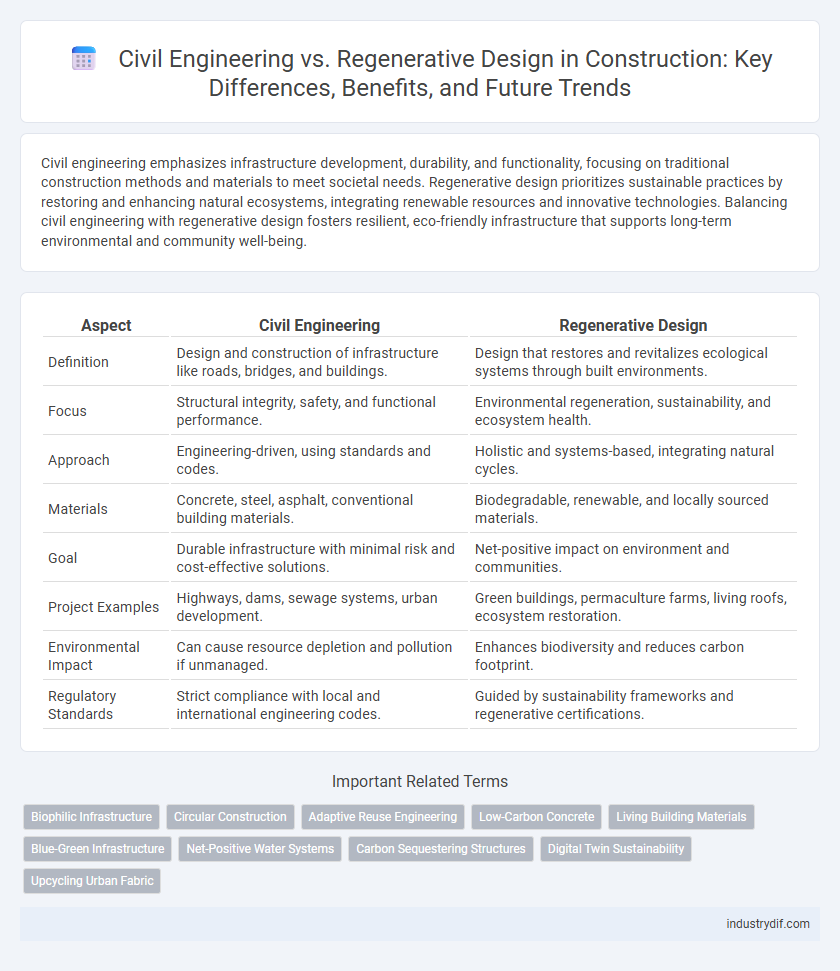
 Civil engineering emphasizes infrastructure development, durability, and functionality, focusing on traditional construction methods and materials to meet societal needs. Regenerative design prioritizes sustainable practices by restoring and enhancing natural ecosystems, integrating renewable resources and innovative technologies. Balancing civil engineering with regenerative design fosters resilient, eco-friendly infrastructure that supports long-term environmental and community well-being.
Table of Comparison
| Aspect | Civil Engineering | Regenerative Design |
|---|---|---|
| Definition | Design and construction of infrastructure like roads, bridges, and buildings. | Design that restores and revitalizes ecological systems through built environments. |
| Focus | Structural integrity, safety, and functional performance. | Environmental regeneration, sustainability, and ecosystem health. |
| Approach | Engineering-driven, using standards and codes. | Holistic and systems-based, integrating natural cycles. |
| Materials | Concrete, steel, asphalt, conventional building materials. | Biodegradable, renewable, and locally sourced materials. |
| Goal | Durable infrastructure with minimal risk and cost-effective solutions. | Net-positive impact on environment and communities. |
| Project Examples | Highways, dams, sewage systems, urban development. | Green buildings, permaculture farms, living roofs, ecosystem restoration. |
| Environmental Impact | Can cause resource depletion and pollution if unmanaged. | Enhances biodiversity and reduces carbon footprint. |
| Regulatory Standards | Strict compliance with local and international engineering codes. | Guided by sustainability frameworks and regenerative certifications. |
Defining Civil Engineering and Regenerative Design
Civil engineering involves the design, construction, and maintenance of infrastructure such as roads, bridges, and buildings, focusing on structural integrity and public safety. Regenerative design emphasizes creating systems that restore and renew environmental health, promoting sustainability beyond traditional construction methods. While civil engineering prioritizes functionality and durability, regenerative design integrates ecological principles to enhance ecosystems and human well-being.
Historical Evolution of Construction Approaches
Civil engineering traditionally emphasizes large-scale infrastructure projects such as bridges, roads, and dams, rooted in centuries-old practices of material durability and structural integrity. Regenerative design, emerging in recent decades, shifts focus towards sustainable construction methods that restore ecosystems and regenerate resources, integrating principles from biomimicry and ecological science. The historical evolution of construction approaches highlights a transition from purely technical efficiency to holistic, environmentally responsive design frameworks.
Key Principles of Civil Engineering
Civil engineering centers on principles such as structural integrity, material strength, and efficient resource management to design and maintain infrastructure like roads, bridges, and buildings. It emphasizes safety standards, load-bearing calculations, and sustainability through optimized use of concrete, steel, and soil mechanics. Regenerative design shifts focus towards restoring ecosystems and integrating natural processes, but civil engineering remains crucial for ensuring durable, functional, and resilient built environments.
Core Concepts of Regenerative Design
Regenerative design in construction emphasizes restoring and enhancing natural systems, creating built environments that actively contribute to ecological health. Core concepts include closed-loop resource cycles, biomimicry, and fostering resilience by integrating ecosystems with infrastructure. This approach contrasts with traditional civil engineering, which primarily focuses on structural integrity and functionality rather than environmental regeneration.
Methods and Materials: A Comparative Analysis
Civil engineering primarily utilizes traditional methods such as reinforced concrete, steel frameworks, and asphalt, emphasizing structural integrity and durability in infrastructure projects. Regenerative design incorporates sustainable materials like rammed earth, bamboo, and recycled composites, focusing on ecological balance and resource renewal through techniques such as biomimicry and closed-loop systems. The comparative analysis highlights that while civil engineering focuses on performance and safety standards, regenerative design prioritizes minimizing environmental impact and fostering long-term ecological health.
Sustainability in Construction: Civil vs. Regenerative
Civil engineering traditionally emphasizes structural integrity and durability, focusing on materials and methods that support long-term infrastructure performance. Regenerative design advances sustainability by integrating natural systems, enhancing ecosystem health, and promoting resource renewal throughout the construction lifecycle. Emphasizing energy efficiency, waste reduction, and ecological restoration, regenerative approaches surpass conventional civil engineering sustainability metrics, fostering resilient, adaptive built environments.
Environmental Impact Assessment
Civil engineering traditionally emphasizes infrastructure durability and efficiency, while regenerative design prioritizes restoring natural ecosystems and enhancing biodiversity. Environmental Impact Assessment (EIA) in civil engineering often measures and mitigates negative effects, whereas in regenerative design, EIA integrates strategies to improve soil health, water cycles, and carbon sequestration. This paradigm shift encourages projects that not only reduce harm but actively contribute to environmental renewal and resilience.
Innovations Driving Change in Both Fields
Innovations in civil engineering emphasize advanced materials like self-healing concrete and smart infrastructure systems embedded with IoT sensors to enhance durability and real-time monitoring. Regenerative design incorporates biomimicry principles and closed-loop resource cycles to restore ecosystems and reduce environmental impact in built environments. Both fields leverage digital twin technology and AI-driven modeling to optimize project efficiency, sustainability, and resilience.
Case Studies: Successful Projects and Lessons Learned
Case studies in civil engineering reveal successful infrastructure projects emphasizing durability, efficiency, and scalability, such as the Millau Viaduct in France, which showcases advanced structural engineering techniques. In regenerative design, projects like the Bullitt Center in Seattle demonstrate sustainable building practices that restore ecosystems and promote energy self-sufficiency, highlighting lessons on material selection and waste reduction. Comparing these approaches underscores the importance of integrating regenerative principles into traditional civil engineering to enhance environmental resilience and long-term project viability.
Future Trends in Construction: Integration and Opportunities
Future trends in construction highlight the integration of civil engineering principles with regenerative design to create sustainable infrastructure that reduces environmental impact and enhances ecosystem health. Innovations such as green building materials, energy-efficient systems, and smart urban planning enable projects that promote resource regeneration and resilience. This convergence fosters opportunities for regenerative urban landscapes, carbon-neutral developments, and adaptive infrastructure meeting climate change challenges.
Related Important Terms
Biophilic Infrastructure
Civil engineering traditionally focuses on structural integrity and functionality, while regenerative design emphasizes creating biophilic infrastructure that integrates natural elements to restore ecosystems and enhance human well-being. Biophilic infrastructure in civil projects incorporates green spaces, natural materials, and ecological connectivity, promoting sustainability and resilience in urban environments.
Circular Construction
Civil engineering traditionally emphasizes infrastructure durability and function, while regenerative design integrates circular construction principles to minimize waste and promote resource reuse throughout the project lifecycle. Circular construction within regenerative design enhances sustainability by closing material loops, reducing environmental impact, and fostering resilient built environments.
Adaptive Reuse Engineering
Adaptive reuse engineering integrates civil engineering principles with regenerative design to transform existing structures into sustainable, functional spaces, minimizing material waste and environmental impact. This approach emphasizes preserving structural integrity while enhancing energy efficiency, aligning with circular economy goals in construction.
Low-Carbon Concrete
Low-carbon concrete in civil engineering reduces carbon emissions by incorporating recycled materials and alternative binders, enhancing sustainability in structural projects. Regenerative design advances this concept by integrating concrete that not only minimizes environmental impact but also supports ecosystem restoration and carbon sequestration within built environments.
Living Building Materials
Civil Engineering traditionally relies on conventional materials like concrete and steel, whereas Regenerative Design emphasizes Living Building Materials such as mycelium-based composites and bio-concrete that actively repair and enhance environmental health. These innovative materials contribute to sustainable construction by reducing carbon footprints and fostering circular economies within urban infrastructure development.
Blue-Green Infrastructure
Blue-Green Infrastructure integrates civil engineering principles and regenerative design to enhance urban resilience by managing stormwater, improving water quality, and providing ecosystem services. Civil engineers focus on structural functionality, while regenerative design emphasizes sustainable, adaptive systems that restore natural hydrological cycles within built environments.
Net-Positive Water Systems
Civil engineering traditionally manages water through infrastructure designed for efficiency and control, while regenerative design integrates net-positive water systems that enhance ecosystem health by capturing, purifying, and reusing water onsite. Net-positive water systems in regenerative design promote sustainable urban water cycles, reducing reliance on external water sources and mitigating environmental impact through green infrastructure like bioswales, rain gardens, and greywater reuse.
Carbon Sequestering Structures
Civil engineering integrates carbon sequestering structures through innovative materials like bio-composites and carbon capture concrete, reducing the carbon footprint of infrastructure projects. Regenerative design emphasizes creating self-sustaining ecosystems within built environments, enhancing carbon sequestration by incorporating green roofs, urban forests, and soil carbon storage systems.
Digital Twin Sustainability
Digital twins in civil engineering enable precise simulation and monitoring of infrastructure performance, drastically improving sustainability by reducing resource waste and extending asset lifespan. In contrast, regenerative design integrates digital twin technology to create systems that actively restore and enhance environmental health, promoting circular resource use and resilience in built environments.
Upcycling Urban Fabric
Civil engineering traditionally focuses on infrastructure development and maintenance, while regenerative design emphasizes upcycling urban fabric by transforming existing structures into sustainable, multifunctional spaces that reduce waste and environmental impact. Incorporating regenerative principles in civil engineering projects enhances resource efficiency and promotes resilient, eco-friendly urban environments.
Civil Engineering vs Regenerative Design Infographic